
Find People Through Banning Records
Banning people search work is strongest when it starts with official systems rather than broad commercial profiles. The City Clerk handles city records and public-record requests. Riverside County Assessor-County Clerk-Recorder keeps recorded documents, clerk filings, vital-record copy paths, and property tools. Riverside Superior Court holds the case index. The California Secretary of State and state boards add voter, business, notary, and license records.
Choose the first search by the clue in hand. A past address points to RivCoView and Map My County. A business name points to fictitious business name records, SOS bizfile, or license boards. A family-history lead may be better served by the Banning Library local history collection than by a modern portal.
- Start with the most precise clue: full name, old address, parcel number, business name, or court case number.
- Use the county recorder or clerk index for deeds, liens, fictitious business names, and notary or registration filings.
- Check court records through Riverside Superior Court when the clue is a case, hearing, probate matter, or party name.
- Use property records when an address is known, then move from APN or owner name into deeds and older records.
- Use the City Clerk, library, or county archives when the needed record is not online.
Note: Banning voter records and protected-address records have use limits, so do not treat every name-bearing file as a public directory.
Banning Records Offices for Search
Three offices anchor most Banning people search work. The city layer starts with the Banning City Clerk, which is the city records custodian, elections official, municipal-code keeper, claims receiver, and CPRA request tracker. The county layer starts with the Riverside County Assessor-County Clerk-Recorder. Court files are separate because Riverside County government does not maintain court records.
Riverside County Recorder
Riverside County office computers
Gateway Riverside for 1974 and earlier
(951) 486-7000
Riverside County Clerk
Riverside County office computers
Gateway Riverside for pre-1975 records
(951) 486-7000
Banning City Requests First
The City of Banning uses NextRequest for local public records. The portal lets users search past requests and produced records before filing a new request. During research it displayed thousands of prior requests, a search control, and a Make Request control. That matters because a fulfilled city request may already contain the agenda packet, permit correspondence, claim material, code record, or other city response tied to a person or address.
The city also links a Laserfiche public records portal. The text crawl did not expose every category in that system, so the safer path is to use City Clerk pages, Laserfiche, and NextRequest together. Community Development is the city fallback for planning, building permits, inspections, and code enforcement when no public lookup is verified.
The Banning NextRequest capture in the manifest shows the public request portal used for city records.
Open the Banning NextRequest portal before filing a duplicate request.
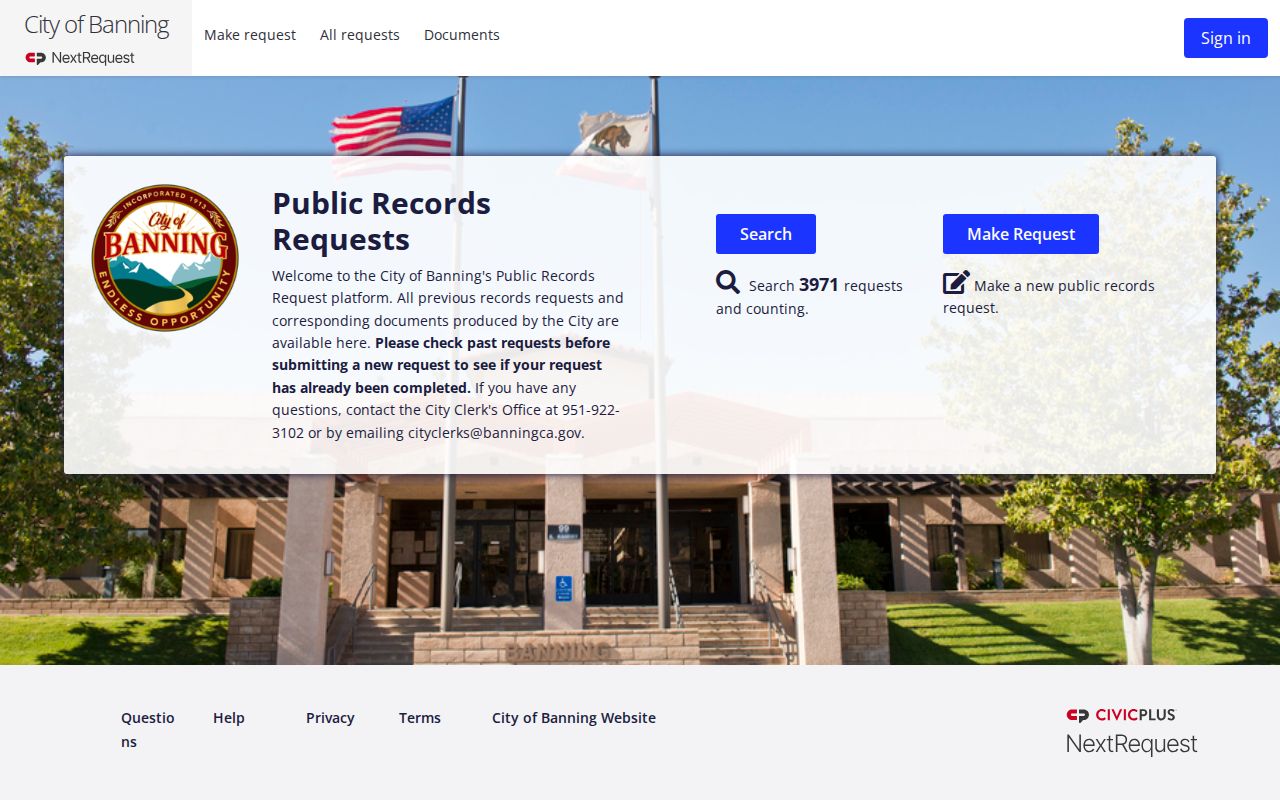
The screenshot supports the city-records workflow: search past responses first, then file a focused request if the record is not already posted.
Riverside Official Records Search
Riverside ACR official records are central to a Banning people search because recorded documents can tie names to deeds, liens, releases, and other filings. The official records self-service portal is the online entry point for copy ordering and record requests, while ACR offices provide public computers for deeper searching. The important date boundary is 1975: office computers search back to that year, and 1974-and-earlier records must be searched at the Gateway Riverside location.
| Search Step | Use It For | Access Point |
|---|---|---|
| Find and select document | Recorded document or copy order | ACR self-service |
| Name and shipping details | Copy fulfillment | Online order workflow |
| Office computer search | Index work back to 1975 | ACR office computers |
| Gateway Riverside | 1974 and earlier records | In-person historical search |
Riverside ACR self-service is one of the strongest official portals for turning a name or property lead into a document trail.
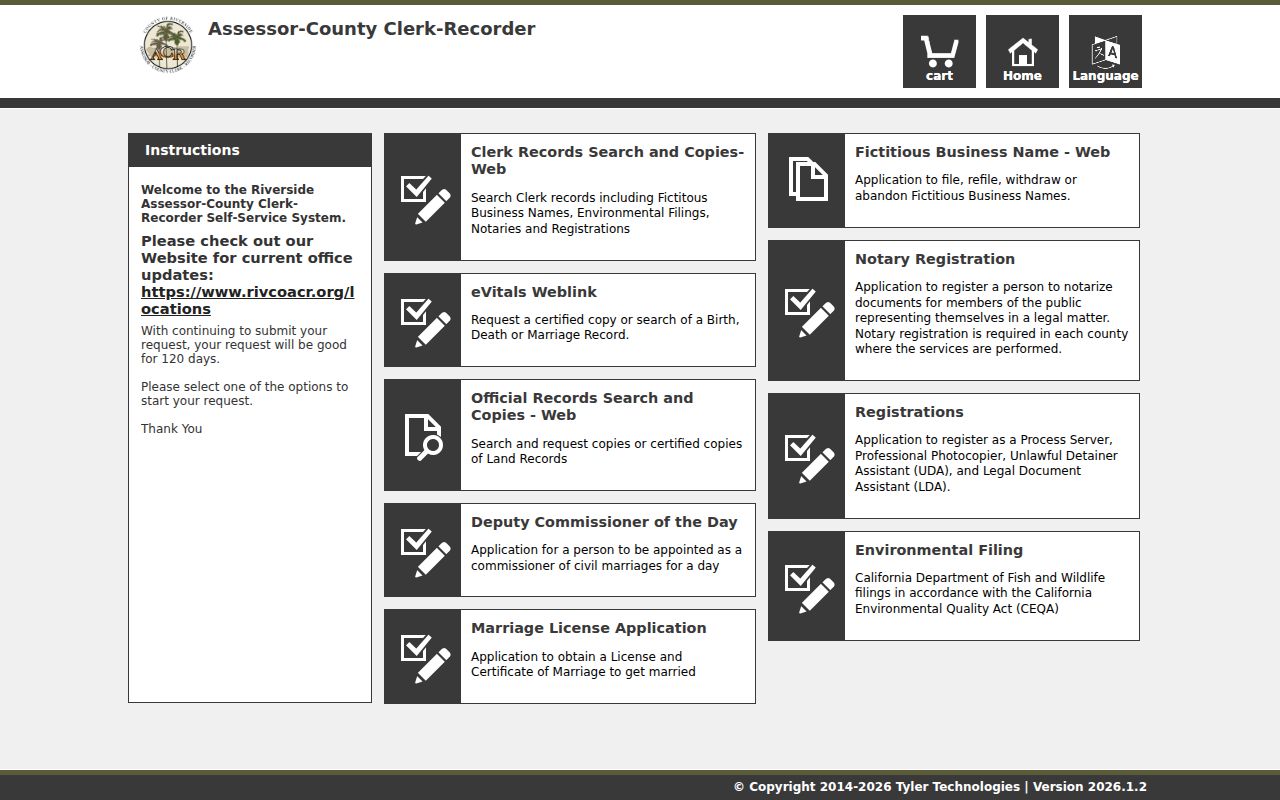
The image belongs in the Banning workflow because city records alone do not hold county deeds, liens, or official record copies.
Banning Court Records by Name
Banning is served by the Superior Court of California, County of Riverside. The local courthouse is the Banning Justice Center at 311 E. Ramsey Street. Online case access runs through Riverside Superior Court Public Access and the Journal Technologies public portal. Riverside County government points users to the court because the county itself does not maintain court records.
The court portal separates search types. Case-number access is free when the required case number is known. A party-name index search requires an online account and a fee. Register of Actions records can show filed documents, filing dates, filing parties, and permitted document access. Calendars show current or future hearings, but sealed, juvenile, confidential, and restricted matters are not treated as open web records.
| Court Channel | Search Method | What It Can Show | Access |
|---|---|---|---|
| Riverside Superior Court Public Access | Case number or paid name search | Case numbers, filing dates, register entries, calendars | Account required for name search |
| Banning Justice Center | Counter or clerk process | Local courthouse file and copy help | Copy and certification fees may apply |
| RI-MC011 copy request | Form request | Copies and certified copies | eSubmit, mail, or drop box |
| PACER | Federal party or case search | Federal district and bankruptcy records | Per-page fee |
The Riverside court Public Access portal shows the county court channel used for Banning cases.
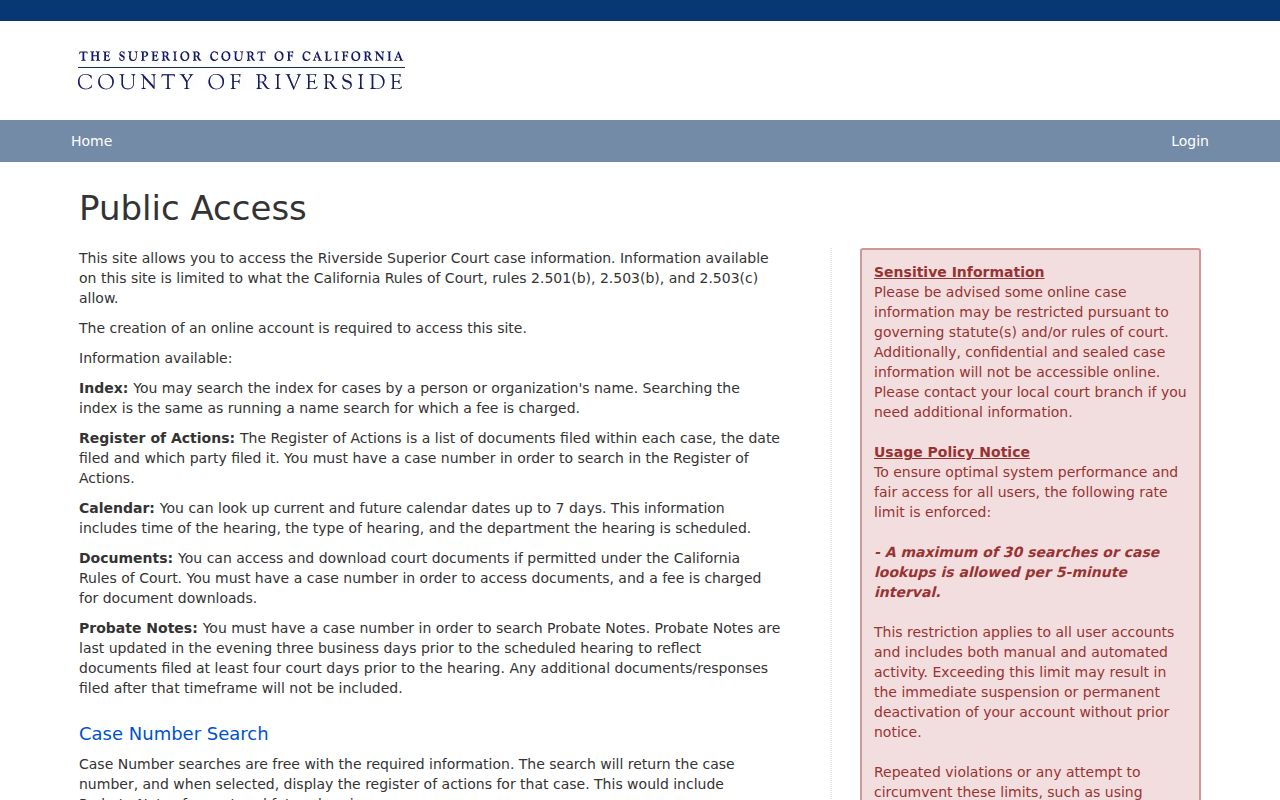
The court portal is useful when a Banning name search needs case numbers, hearing clues, or a copy request path instead of city records.
Banning Address to Owner
Property records can turn a Banning address into names. RivCoView is the public real-property data portal. It accepts a 9-digit PIN/APN without dashes or a property address with street number and street name. The assessor maps page explains that map PDFs show parcel numbers, lot boundaries, recorded dimensions, acreage, street widths, adjoining parcels, and recorded map information. Ownership and street address details come through the property data portal, not the map PDF alone.
- APN or PIN
- A parcel identifier. RivCoView expects a 9-digit number without dashes.
- Situs address
- The property location. It may differ from the owner's mailing address.
- Grantor and grantee
- The seller or transferring party and the receiving party in recorded documents.
RivCoView is the official portal for a Banning property search by APN or address.
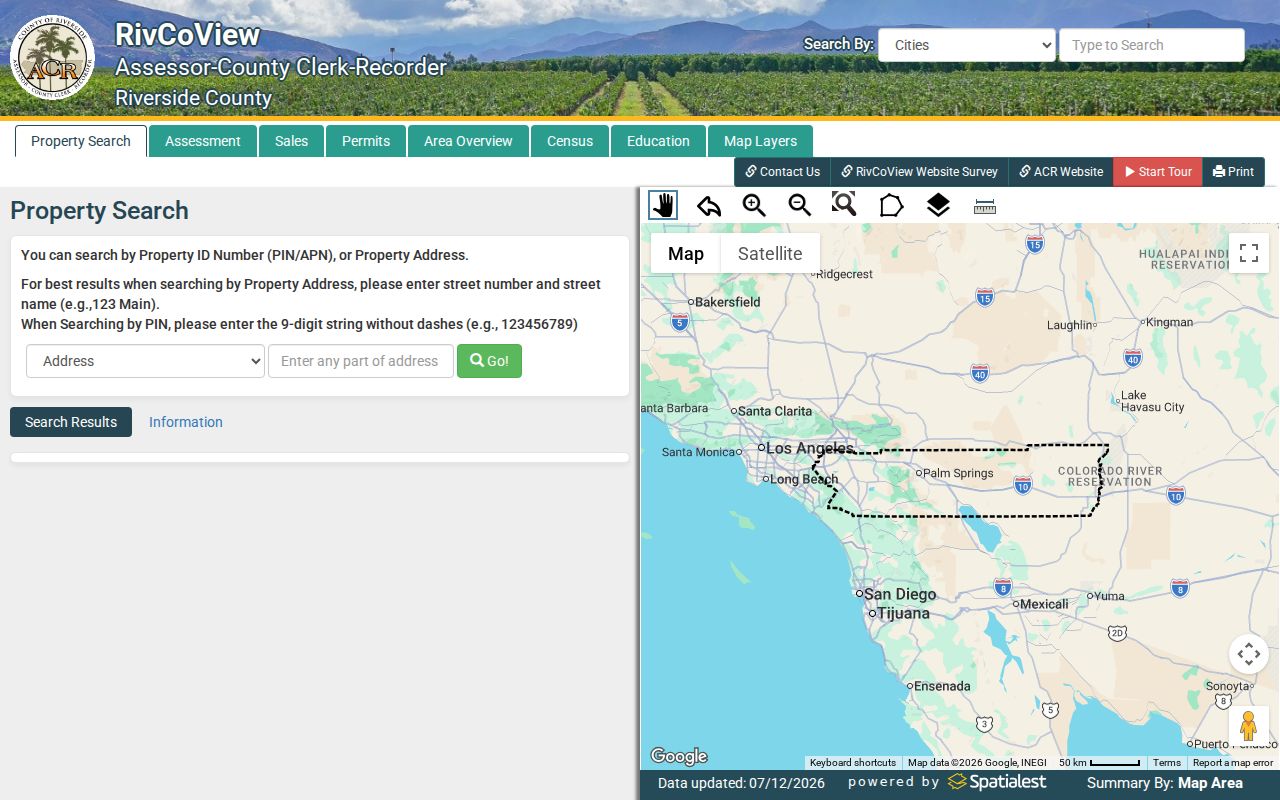
The portal helps connect a current Banning address to parcel data before the search moves into recorded deeds or older directories.
Vital Records for Banning Families
Birth, death, marriage, and divorce records have more limits than many name indexes. Riverside University Health System registers recent births and deaths, Riverside ACR issues Riverside County birth, death, and marriage certificates after receipt, and CDPH-VR issues statewide certified copies and certain dissolution certificates. California Health and Safety Code section 103526 limits authorized certified copies of birth, death, and marriage records to authorized persons. Others may receive informational certified copies.
For family history, do not rely only on certificate copies. Obituaries, yearbooks, local newspapers, telephone books, cemetery clues, probate filings, and recorded property transfers can point to a date, family group, or name variant when a certified copy is restricted. Divorce decrees are court records, not county marriage certificates, so the search path changes to Riverside Superior Court.
Riverside ACR vital-records instructions explain county certificate copy paths for Banning events.
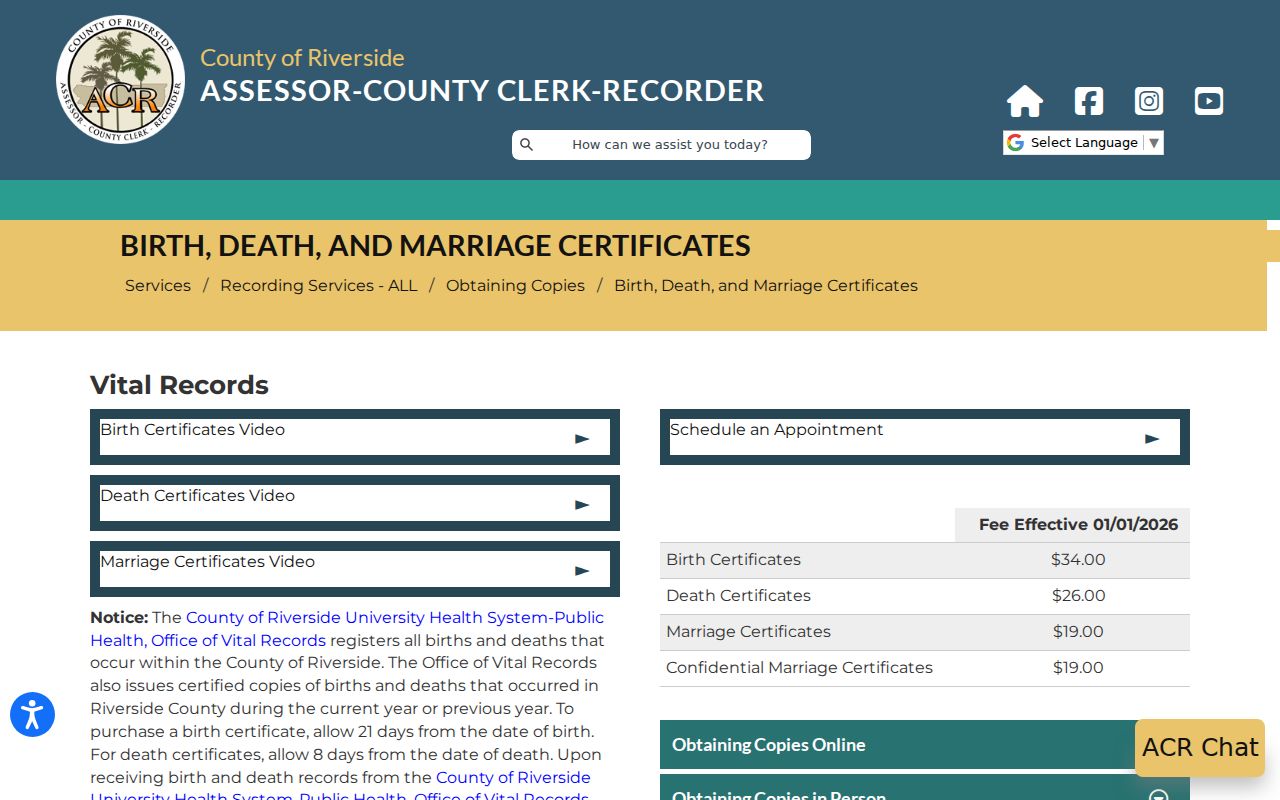
The screenshot fits the vital-records section because it shows where county copy rules and application paths are published.
Voter Records Are Limited
California's My Voter Status tool can help a voter check registration, party preference, language preference, ballot status, polling place, and election materials. It is not a browse-all-voters directory. California voter registration information is governed by Elections Code sections 2188, 2194, and 18109, Government Code section 7924.000, and California Code of Regulations sections 19001-19013.
For Banning, local election administration runs through the Riverside County Registrar of Voters. Full voter-file access is purpose-limited to election, scholarly, journalistic, political, or governmental uses. It may not be used for harassment or general private lookup. The more complete record set belongs on the Banning voter registration records page.
Use limit. Voter data is not a general people directory, and protected-address programs can suppress residential details.
California My Voter Status is the state lookup shown in the Banning screenshot set.
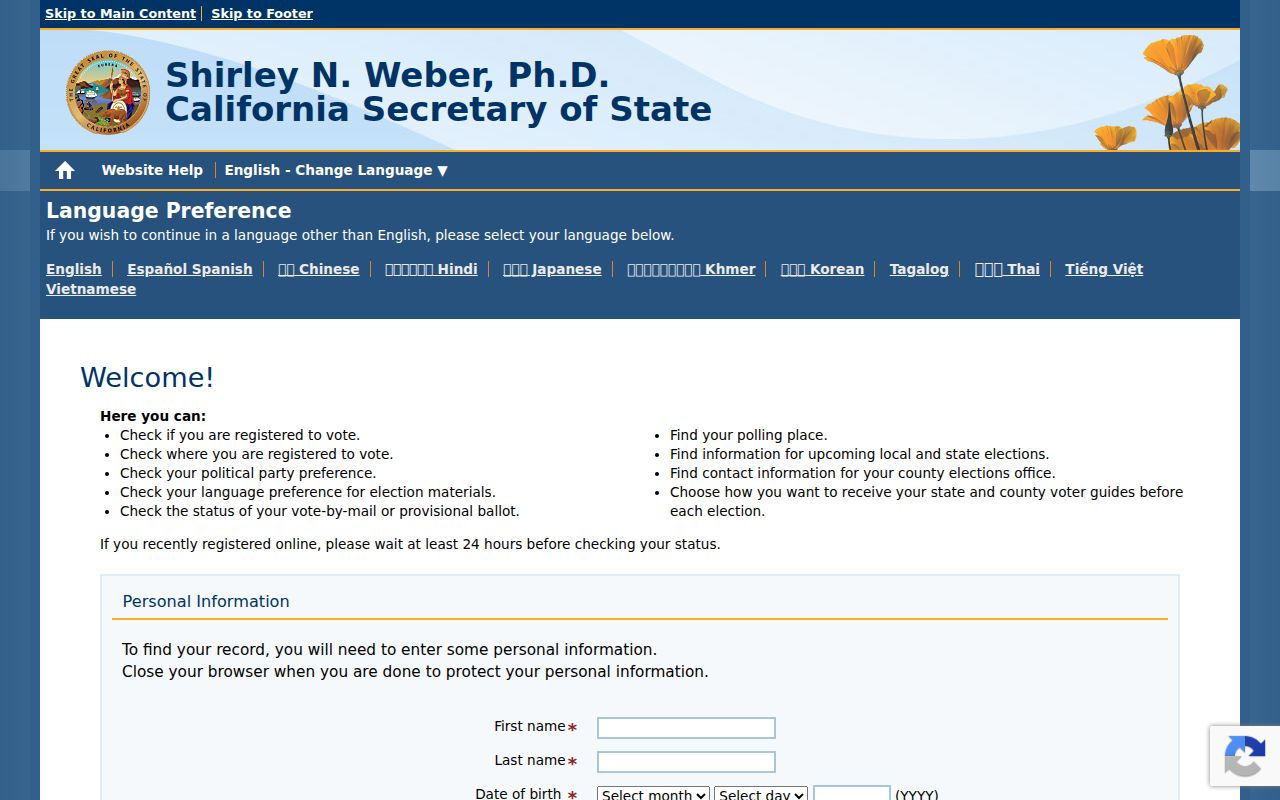
The tool belongs in a Banning search only when the person using it has a lawful voter-status reason and the required identity details.
Banning Library Name Trails
The Banning Library District local history collection is the strongest non-county people source. The OAC finding aid dates the collection from 1890 to 2010 and says it documents the San Gorgonio Pass from the 1880s to present. It includes photographs, newspapers and clippings, telephone books, Banning High School annuals, scrapbooks, maps, pamphlets, the Boud Collection, and the Barker Collection.
This matters for old Banning addresses and family searches. The collection includes microfilm of the Banning Record Gazette from 1909 to present and hard copies of Banning Live Wire from 1941 to 1952. Yearbooks and photo archives can locate classmates, teachers, civic groups, parade participants, business owners, and families who do not appear in modern web records.
| Local Source | People Clues | Coverage in Research |
|---|---|---|
| Banning Record Gazette | Obituaries, legal notices, school and civic news | Microfilm from 1909 to present |
| Banning Live Wire | Local news and names | Hard copies from 1941 to 1952 |
| Banning High annuals | Students, faculty, teams, clubs | Held in local collection |
| Telephone books | Residents, addresses, businesses | Exact year run not verified |
Business and License Clues
Business records can identify a person through a company, agent name, fictitious business name, license, or filing address. California SOS bizfile Online searches corporations, LLCs, and limited partnerships. Riverside County Clerk records cover fictitious business names, environmental filings, notaries, and registrations. Mail FBN searches require an exact business name and, when applicable, the owner's name.
California DCA License Search verifies licenses issued by DCA boards and bureaus, with current, expired, and discipline status where available. Not all boards live in the same DCA search, so contractors, real estate, court reporters, and some other records may route to separate official systems. For Banning, these searches are most useful when a person is tied to construction, real estate, health care, services, or a local business address.
California SOS bizfile appears in the home screenshot set as a statewide business lookup.
Business records are often a clean way to connect a Banning name to an agent, entity, or filing address without guessing from a broad web profile.
Jail and Registry Lookups
The Riverside County Sheriff Inmate Information System is the county custody lookup. The research captured a mandatory last-name field, with first name and date of birth as optional search refinements. State prison custody is separate through CDCR, and the California Megan's Law Website discloses only information legally permitted under Penal Code section 290.46.
These systems should be used with care. They are not proof of a person's full history, and some records are sealed, restricted, outdated, or legally withheld. Use official custody or registry pages for verification rather than reposted copies from third-party sites.
Riverside Sheriff's inmate locator is the county lookup captured for Banning people search work.
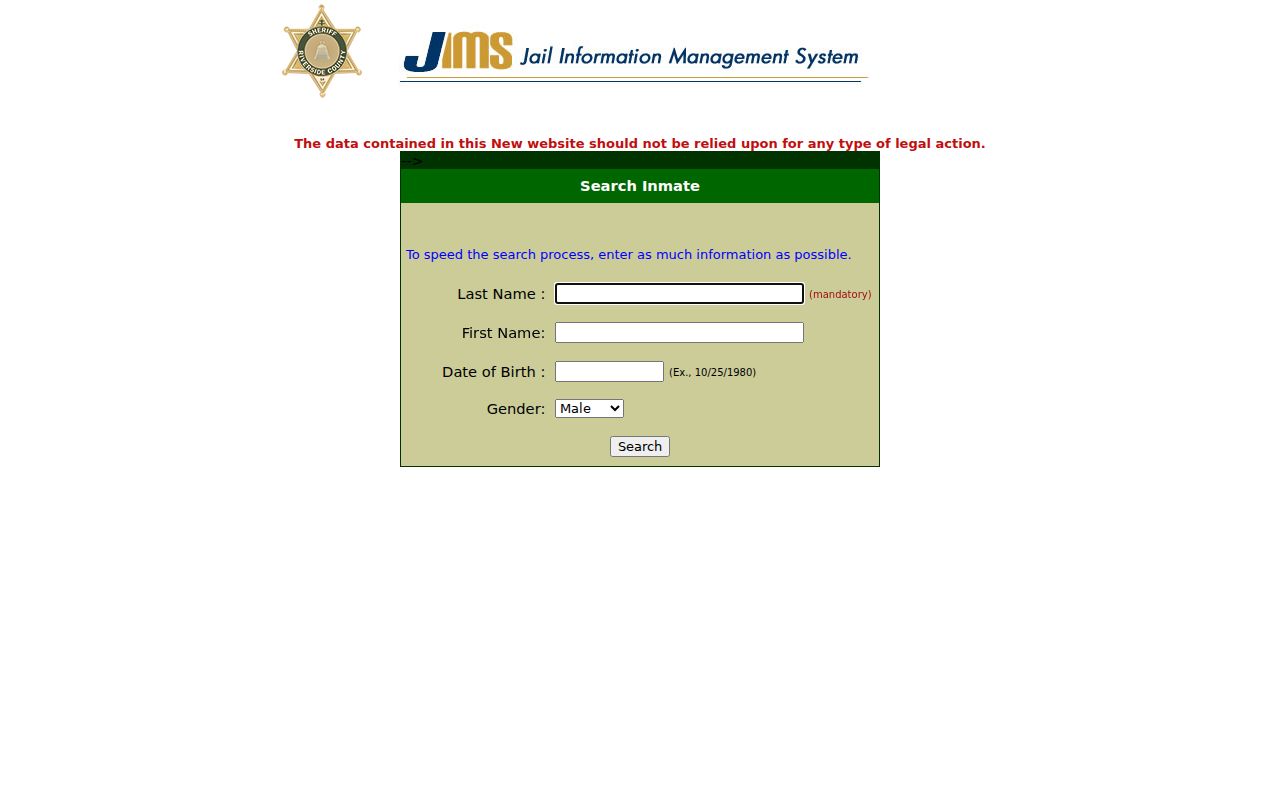
The screenshot shows why a last name is the starting point for the county custody search.
Official vs Commercial Search
Commercial people-search services can be useful as broad clue sources, but they are not custodians. They may combine old addresses, phone data, scraped records, and private-source data. Accuracy varies. Official records give narrower facts from named offices, with clearer access rules and correction paths. A good Banning search may use commercial results only as leads, then verify with the city, county, court, state, library, or archive that actually holds the record.
| Source Type | Best Use | Main Limit |
|---|---|---|
| Official city or county records | Verified filings, requests, property, court, and copy paths | May require a portal, fee, counter visit, or request |
| Library and archives | Historical names, old addresses, classmates, obituaries | Some holdings require staff help or in-person use |
| Commercial people finders | Possible clues when official starting facts are weak | Stale data, mixed sources, and lawful-use limits |
Banning Privacy and Opt Outs
California privacy rules affect both official records and data brokers. Safe at Home provides a substitute mailing address for qualifying participants, and protected addresses should not be forced into a public search result. Voter data has its own purpose limits. DMV data is protected by federal and state law. Court, vital, juvenile, sealed, and protected-person records may be withheld or redacted.
The California Privacy Protection Agency says data-broker registration moved to CalPrivacy in 2024, the DROP deletion mechanism is available to consumers in 2026, and data brokers begin processing deletion requests on August 1, 2026. For commercial people-search opt-outs, use each company's suppression process, share only what is needed to verify the request, and recheck later because data may reappear from new sources.